0510-83570861


2026-08-31
In high-volume needle bearing production, machine reliability is not simply a question of whether equipment can run continuously. The more important issue is whether the machine can maintain dimensional stability, repeatable surface quality, controlled processing forces, and predictable cycle times as production volume increases. A machine that produces accurate components for the first few hours but gradually loses consistency under continuous operation creates more downstream problems than it solves.
For needle bearing manufacturers, reliability therefore has to be evaluated as a combination of mechanical rigidity, process control, thermal stability, tooling consistency, and maintainability. These factors determine whether a production line can maintain the required quality from the first component of a shift to the last.
The most important characteristics are structural rigidity, spindle stability, precise workpiece positioning, consistent abrasive or tooling conditions, and effective control of processing parameters.
Needle bearing components often have demanding dimensional and surface requirements. Small deviations in roundness, diameter, cylindricity, or surface condition can influence how components interact with mating parts. As production volume increases, even a small systematic deviation can quickly become a large batch-quality problem.
A reliable machine should therefore minimize variation rather than merely achieve a nominal specification under ideal conditions.
Machine rigidity directly influences how the equipment responds to cutting, grinding, or superfinishing forces. If the machine structure, spindle assembly, workholding system, or guide mechanism lacks sufficient stiffness, process forces can produce unwanted displacement or vibration.
This becomes particularly important when processing small bearing components at high throughput. The machine may still complete every cycle, but the resulting parts can gradually show changes in geometry or surface condition.
For this reason, buyers should examine not only the machine's maximum processing capacity but also the design of its base, workholding arrangement, spindle system, guideways, and critical moving assemblies.
Temperature is an often-overlooked source of dimensional variation. Continuous operation generates heat through motors, bearings, spindles, hydraulic systems, friction, and material removal. If that heat is not controlled, machine components can expand and change the relative position between the workpiece and tooling.
For high-volume production, thermal stability should therefore be considered alongside nominal positioning accuracy. A machine may initially meet a tight tolerance, yet produce a different result after several hours of continuous operation if its thermal behavior is poorly controlled.
Effective coolant management, appropriate lubrication, stable spindle operation, and sensible machine warm-up procedures can all contribute to more predictable long-run performance.
Process control is what converts machine capability into repeatable production. Important variables may include spindle speed, feed rate, workpiece rotation, grinding or finishing pressure, abrasive condition, coolant flow, and cycle time.
Rather than allowing operators to make frequent manual adjustments, a well-designed production machine should keep critical parameters within a controlled range. This reduces operator-dependent variation and makes process results easier to reproduce across shifts.
Manufacturers evaluating bearing manufacturing machines should therefore look beyond the machine's headline specifications. The more useful question is how the equipment controls the process under actual production conditions.
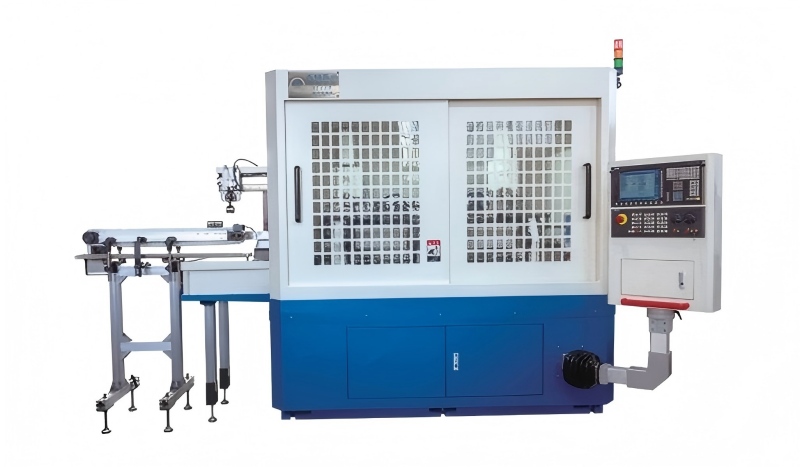
Dimensional accuracy alone does not define the quality of a bearing component. Surface characteristics can affect friction, lubrication behavior, contact conditions, wear, and the service life of mating components.
In finishing operations, the objective is often to remove or reduce undesirable surface characteristics left by previous machining processes while maintaining the required geometry. This makes bearing surface finish an important consideration when assessing the final capability of a production system.
For needle bearing production, manufacturers should evaluate surface roughness together with waviness, form accuracy, and the consistency of the result across the complete batch. A low roughness value by itself does not necessarily indicate a superior finishing process if the underlying geometry has been compromised.
Yes. Tool and abrasive condition can have a significant influence on process repeatability.
As tooling wears, its interaction with the workpiece changes. Cutting forces, material removal rates, contact conditions, and resulting surface characteristics may all shift. In a low-volume environment, an operator may detect and compensate for this change. In automated high-volume production, uncontrolled tool wear can affect hundreds or thousands of components before the problem becomes obvious.
Reliable equipment should therefore provide a practical approach to tool-life management, dressing, replacement, inspection, or compensation where applicable.
A bearing machine cannot be evaluated independently from the upstream and downstream processes. The quality entering a finishing operation determines what the machine needs to correct. Likewise, the quality leaving the machine affects subsequent assembly and inspection operations.
For example, surface grinding may establish important dimensional and geometric characteristics before a final finishing operation. Understanding the role of a surface lapping machine within the broader production sequence can help engineers determine whether a proposed process is actually capable of delivering the required final condition.
This process-chain perspective is particularly important when designing automated bearing production lines. A machine should not be selected only because it performs one operation efficiently; it should fit the quality requirements of the complete manufacturing route.
A meaningful acceptance test should simulate production rather than rely exclusively on an unloaded machine demonstration. Buyers can request sample processing using representative workpieces, actual or equivalent tooling, and defined production parameters.
Useful acceptance criteria may include:
Dimensional repeatability over multiple production cycles
Roundness and cylindricity consistency
Surface roughness and waviness results
Cycle-time stability
Spindle and machine thermal behavior
Tool or abrasive consumption
Operator adjustment requirements
Inspection and process documentation
Machine reliability continues after commissioning. Preventive maintenance should focus on the components that most directly influence process accuracy, including spindles, bearings, guides, lubrication systems, coolant systems, workholding components, and critical tooling assemblies.
Production data can also be used to identify gradual process drift. Tracking dimensional measurements and surface-quality results over time helps manufacturers distinguish random variation from systematic changes caused by machine wear, tooling degradation, or environmental conditions.
Ultimately, a reliable needle bearing machine is one that produces predictable results rather than simply operating without an obvious mechanical failure. High-volume precision production depends on maintaining that predictability across long operating periods, repeated cycles, changing tooling conditions, and different production shifts.
 What Is the Bearing's Superfinishing Process? Is Superfinishing Important for Bearings?January 13, 2026The superfinishing process is not only used in the bearing industry but is also extensively utilized in engine manufacturing. Additionally, other precision machinery and instruments are beginning to a...viewThe Technological Frontiers of Ultra-Precision Manufacturing and Micro-Precision ManufacturingJanuary 13, 2026In the era of continuous breakthroughs in modern manufacturing technology, "precision" is no longer just a numerical indicator but the core force behind product performance, function realiza...view
 Choosing the Right Roller Bearing Superfinishing Machine for Your Bearing FactoryJuly 8, 2026Selecting the right Roller Bearing Superfinishing Machine directly affects bearing accuracy, surface roughness, production efficiency, and long-term manufacturing costs. The ideal solution depends on ...view
 Call us on:
  Email Us:
  No. 52-1 Zhang Road, Meicun Industrial Park, New District, Wuxi City, Jiangsu, China.