0510-83570861


2025-10-21
In precision manufacturing, grinding and superfinishing are both essential processes—but they serve very different purposes. Grinding defines geometry and dimensional accuracy, while superfinishing refines the surface to achieve ultra-low roughness and superior functional performance.
If your goal is ultimate precision, low friction, and long component life, a superfinish machine provides the final perfection that grinding alone cannot deliver.
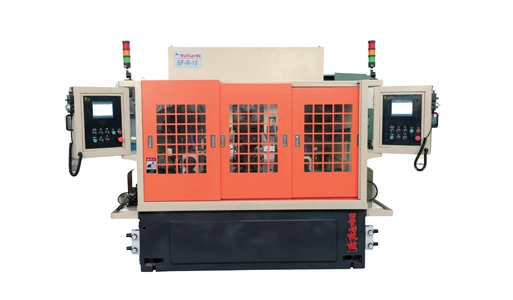
Grinding is a material removal process using abrasive wheels at high speed. It shapes and sizes a component precisely but leaves a directional pattern (grinding marks) and potential thermal stress.
Superfinishing, in contrast, removes only 1–2 μm of material using fine abrasive stones or films under low pressure. The goal isn't geometry correction—but to create a mirror-like plateau surface free of residual stress.
| Parameter | Grinding | Superfinishing |
Material Removal Rate | High (10–50 μm/pass) | Very Low (1–2 μm total) |
Surface Roughness (Ra) | 0.1–0.4 μm | 0.01–0.05 μm |
Surface Texture | Directional marks | Plateau finish, mirror-like |
Heat Generation | High | Negligible |
Residual Stress | Possible tensile stress | Relieved, compressive stress |
Dimensional Correction | Yes | No (maintains geometry) |
Superfinishing doesn't replace grinding—it completes it. Grinding sets the shape; superfinishing perfects the surface.
Using a superfinish machine delivers measurable improvements in performance-critical components:
Reduced Friction and Wear: Plateaued surface reduces metal-to-metal contact.
Longer Bearing Life: Eliminates surface micro-defects that initiate fatigue cracks.
Lower Noise and Vibration: Essential for EV motors, gear systems, and turbines.
Improved Lubrication Retention: Micro-valleys hold oil films under load.
Enhanced Dimensional Stability: Gentle process prevents distortion.
Used for:
Cylindrical and surface finishing
Tolerance correction
Pre-finishing of hardened steels
Examples: Shafts, gears, dies, and cutting tools.
Used for:
Final surface refinement
Improving fatigue strength and efficiency
Examples: Crankshafts, camshafts, bearing races, hydraulic spools, aerospace components.
Yes. Superfinishing achieves sub-micron surface finishes (Ra ≤ 0.01 µm) that grinding cannot match. However, grinding is still needed to define the part's geometry before superfinishing.
No. Superfinishing complements grinding—it doesn't replace it. Grinding corrects geometry and removes bulk material; superfinishing refines the micro-surface layer for better performance.
After grinding, Ra is typically 0.2–0.4 µm. After superfinishing, Ra can drop to 0.01 µm or lower, producing a near-mirror finish.
Because grinding introduces residual stress and directional marks, which can lead to wear and fatigue. Superfinishing removes that damaged layer, creating a stable, stress-free surface ideal for high-precision parts.
Automotive, aerospace, bearing manufacturing, and precision hydraulic equipment industries rely heavily on superfinish machines for critical components that demand long life and consistent performance.
Manufacturers producing high-value components—such as bearings, gears, and crankshafts—gain a clear competitive edge with superfinishing. By integrating a superfinish machine into your process:
Surface quality improves by 80–90%
Friction loss decreases up to 30%
Part lifespan extends significantly
Noise and energy consumption are reduced
In short, superfinishing transforms "good precision" into world-class precision.
Grinding is essential for shaping and sizing, but superfinishing defines true precision. It turns a geometrically correct component into a functionally superior one. For industries that demand maximum durability and performance, investing in a superfinish machine is not just a technological upgrade—it's a strategic advantage.
 What Is the Bearing's Superfinishing Process? Is Superfinishing Important for Bearings?January 13, 2026The superfinishing process is not only used in the bearing industry but is also extensively utilized in engine manufacturing. Additionally, other precision machinery and instruments are beginning to a...view
 Technology and Applications of Surface Grinding Machines, Surface Finishing Machines, and Surface Lapping MachineJanuary 13, 2026In modern manufacturing, the quality of part surfaces directly affects product performance, service life, and assembly precision. Surface grinding machines, surface finishing machines, and surface lap...view
 What Industries Benefit Most from Super Finisher Machines?November 14, 2025Industries that require high precision, low friction, and long component life benefit most from super finisher machines — including automotive, aerospace, bearing manufacturing, hydraulic, medical, a...view
 Call us on:
  Email Us:
  No. 52-1 Zhang Road, Meicun Industrial Park, New District, Wuxi City, Jiangsu, China.