0510-83570861


2025-04-16
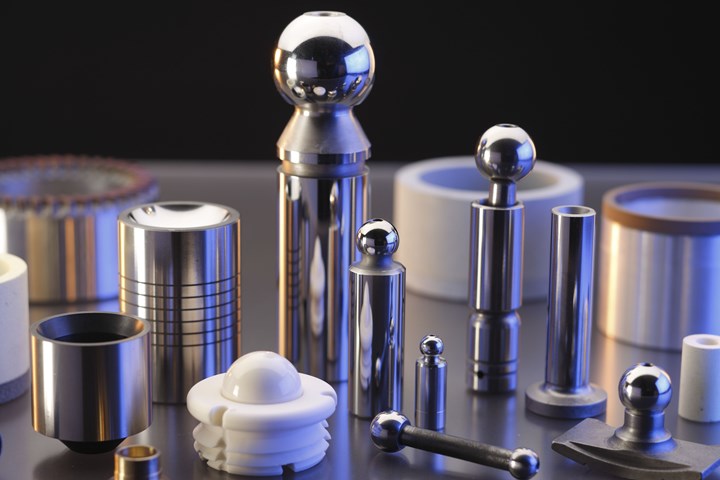
After a metal piece is ground to an initial finish, it is superfinished with a finer grit abrasive stone. The stone is oscillated or rotated while the workpiece is moved in such a way that each bonded grain of abrasive follows a random path with variations in speed, direction and pressure. This multi-motion is a key feature of superfinishing because it prevents the sort of smeared finish that results from built up edge.
In this way, superfinishing is similar to lapping, but with a bonded abrasive stone rather than loose or embedded abrasive. The geometry of the stone depends on the geometry of the workpiece surface; A lubricant is used to minimize heat production, which can alter the metallurgical properties, and to carry away the swarf.
After a metal component has been ground to its required geometry and basic surface finish, superfinishing is applied as a final precision process using a much finer grit abrasive stone. This step is not intended to change the part's dimensions, but to refine the surface layer and remove the micro-damage introduced during grinding.
During superfinishing, the abrasive stone is either oscillated, rotated, or short-stroke reciprocated against the workpiece, while the workpiece itself is simultaneously rotated or moved. This creates a complex multi-motion interaction between the abrasive tool and the surface. As a result, each bonded abrasive grain follows a random, non-repeating path with continuously changing speed, direction, and contact pressure.
This controlled randomness is a defining feature of the superfinishing process. Unlike single-direction machining, the multi-motion action prevents directional scratches and avoids the formation of a smeared or glazed surface, which is commonly caused by built-up edge or localized plastic deformation. Instead, surface asperities are gently sheared off, producing a uniform, plateaued surface structure with excellent functional properties.
In principle, superfinishing is similar to lapping, as both processes aim to improve surface roughness and integrity rather than remove bulk material. However, the key difference lies in the use of a bonded abrasive stone in superfinishing, rather than loose or embedded abrasive particles. This bonded abrasive ensures better control, higher repeatability, and improved process stability, making superfinishing far more suitable for automated and high-volume production environments.
The geometry of the abrasive stone is carefully designed to match the geometry of the workpiece surface. For example, concave stones are used for bearing inner raceways, convex stones for outer raceways, and flat stones for shafts or planar surfaces. This precise conformity ensures consistent contact pressure and uniform material removal across the entire surface.
A lubricant—typically oil or a low-viscosity emulsion—is continuously supplied during the process. The lubricant plays a critical role by:
Minimizing friction and heat generation,
Preventing thermal damage that could alter metallurgical properties,
Flushing away swarf and debris from the contact zone,
Stabilizing the cutting action of the abrasive grains.
By maintaining a low-temperature, low-stress environment, superfinishing preserves the material's surface integrity while delivering exceptionally low roughness and high fatigue resistance.
 Choosing the Right Roller Bearing Superfinishing Machine for Your Bearing FactoryJuly 8, 2026Selecting the right Roller Bearing Superfinishing Machine directly affects bearing accuracy, surface roughness, production efficiency, and long-term manufacturing costs. The ideal solution depends on ...viewWhy Use Superfinishing?March 7, 2025Bearing from the mill often have a finish that is not particularly smooth or aesthetically pleasing. To improve their surface quality and appeal, and superfinishing processes must be used.Superfinishi...viewCan Superfinishing Replace Traditional Polishing Processes Entirely?November 14, 2025In most precision industries, superfinishing has already replaced traditional polishing for critical components — but not in every case.A super finishing machine delivers far superior control over su...view
 Call us on:
  Email Us:
  No. 52-1 Zhang Road, Meicun Industrial Park, New District, Wuxi City, Jiangsu, China.