0510-83570861


2025-10-21
When it comes to achieving exceptional surface integrity, superfinishing outperforms both lapping and polishing in terms of consistency, stress control, and performance enhancement.
While lapping and polishing improve surface appearance and flatness, a superfinish machine produces a functionally superior surface — one that enhances load-bearing capacity, reduces friction, and extends component life.
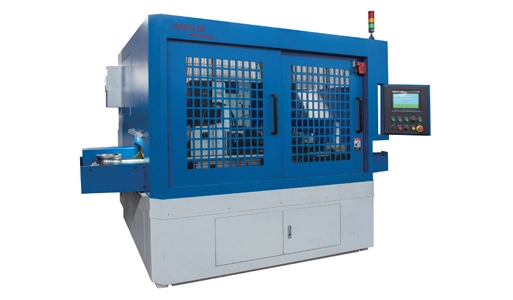
The main distinction lies in purpose.
Lapping and Polishing aim to improve aesthetic smoothness and flatness. They are often used for optical parts or sealing surfaces where reflectivity and appearance matter most.
Superfinishing, however, is engineered to improve functional performance. It removes the damaged layer left by grinding or lapping, creating a plateaued, stress-free surface that enhances part durability.
| Parameter | Lapping | Polishing | Superfinishing |
Primary Purpose | Achieve flatness and tight tolerances | Enhance surface shine and smoothness | Improve surface functionality and lifespan |
Material Removal Rate | Moderate | Very low | Very low (1–2 µm) |
Surface Roughness (Ra) | 0.05–0.2 µm | 0.02–0.1 µm | 0.01–0.03 µm |
Surface Texture | Random, matte | Glossy but directional | Plateau finish with controlled micro-geometry |
Residual Stress | Often remains | Can introduce smear or tension | Completely removed; compressive layer formed |
Geometry Correction | Partial | Minimal | Maintains geometry with high precision |
Lubrication Retention | Limited | Poor | Excellent (due to plateau surface) |
Functional Integrity | Moderate | Aesthetic only | Superior — enhances wear and fatigue resistance |
Conclusion: Superfinishing doesn't just make a part look perfect — it makes it perform perfectly.
Surface integrity goes beyond smoothness. It involves the mechanical, metallurgical, and functional condition of a surface layer. A superfinish machine improves all three:
Removes the heat-affected layer created by grinding or lapping.
Eliminates micro-cracks, peaks, and residual stress, preventing early fatigue.
Creates a plateaued surface with micro-valleys that retain lubrication.
Reduces friction and wear, improving efficiency in motion components.
For high-performance industries—aerospace, automotive, precision bearings, and medical devices—superfinishing ensures consistent performance under demanding conditions.
| Process | Typical Applications |
Lapping | Mechanical seals, optics, gauge blocks, valve seats |
Polishing | Decorative parts, molds, semiconductor wafers |
Superfinishing | Crankshafts, camshafts, bearing races, hydraulic spools, precision shafts |
While lapping and polishing focus on looks and flatness, superfinishing delivers endurance and precision — key in industries where component failure is not an option.
Yes. Lapping improves flatness, but superfinishing delivers better surface integrity by removing micro-damage, improving fatigue strength, and reducing friction.
In most performance-based applications, yes. Superfinishing creates mirror-like finishes with far greater functional benefits, though polishing may still be used for decorative or optical purposes.
A superfinish machine can achieve surface roughness levels as low as Ra 0.01 µm, depending on material hardness and abrasive selection.
Because it enhances lubrication retention, reduces wear, and eliminates stress concentration — all critical for components that operate under load and speed.
Absolutely. By removing the damaged surface layer and generating a compressive stress zone, superfinishing extends fatigue life by 2–3 times compared to lapped or polished parts.
Investing in a superfinish machine is a long-term gain for manufacturers focused on performance consistency and precision quality. Benefits include:
Higher productivity through shorter finishing cycles.
Automation-ready process with repeatable results.
Reduced rejection rates due to superior surface integrity.
Improved product lifespan, minimizing warranty costs.
In today's competitive manufacturing landscape, superfinishing isn't just a finishing option—it's a strategic advantage.
While lapping and polishing enhance appearance, superfinishing defines functional excellence. For components that must perform under stress—bearings, shafts, valves, and gears—only superfinishing delivers the surface integrity, fatigue resistance, and dimensional precision required.
A superfinish machine isn't just a tool for finishing—it's an investment in performance, reliability, and customer confidence.
 What Industries Benefit Most from Super Finisher Machines?November 14, 2025Industries that require high precision, low friction, and long component life benefit most from super finisher machines — including automotive, aerospace, bearing manufacturing, hydraulic, medical, a...viewWhy Use Superfinishing?March 7, 2025Bearing from the mill often have a finish that is not particularly smooth or aesthetically pleasing. To improve their surface quality and appeal, and superfinishing processes must be used.Superfinishi...viewAchieving Mirror-Like Surface Finishes: Super Finishing vs. Traditional MethodsSeptember 3, 2025When it comes to mirror-like surface finishes, traditional processes such as grinding, lapping, or polishing can only go so far. They remove material effectively but often leave directional marks, hea...view
 Call us on:
  Email Us:
  No. 52-1 Zhang Road, Meicun Industrial Park, New District, Wuxi City, Jiangsu, China.