0510-83570861

2025-11-19
Bearing manufacturers use integrated grinding and superfinishing lines to achieve higher precision, longer bearing life, and improved production efficiency.
By combining a ball bearing grinding machine and a superfinishing system within the same automated workflow, manufacturers ensure consistent geometry, flawless surface texture, and reduced cycle time — all while minimizing manual handling and measurement errors.
In short, integration bridges geometry accuracy (from grinding) with surface perfection (from superfinishing) — the two critical parameters that define bearing performance.
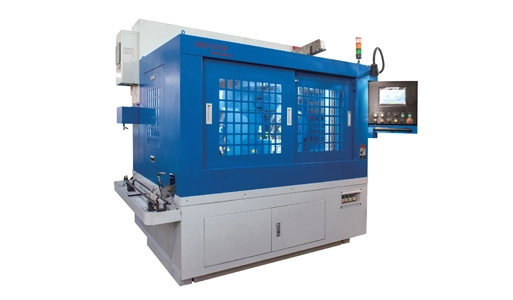
A ball bearing grinding machine shapes the fundamental geometry of the bearing ring or rolling element. It ensures:
Dimensional accuracy (bore/outer diameter, roundness, cylindricity)
Correct curvature on raceways
Tight tolerances within micrometers
However, the grinding process also leaves behind microcracks, residual stress, and directional tool marks, which negatively impact fatigue life and friction.
Superfinishing removes the surface damage layer left by grinding and develops the plateaued texture necessary for ideal lubrication performance.
It refines the surface from Ra ≈ 0.2–0.3 µm after grinding to as low as Ra ≈ 0.01–0.02 µm, ensuring a smooth, mirror-like raceway with excellent oil film stability.
When these two processes are integrated, the result is a bearing component that’s not only dimensionally precise but also tribologically optimized.
Traditional setups require manual transfer between grinding and finishing stations. Integration eliminates this step.
Automated transfer systems move parts directly from the ball bearing grinding machine to the superfinishing station.
This reduces human error, speeds up throughput, and improves process consistency.
Manufacturers typically report 15–25% reduction in total cycle time and better repeatability when both processes are combined in a single automated line.
The moment grinding is completed, superfinishing can begin — before surface oxidation or contamination occurs.
This minimizes:
Dimensional drift due to thermal relaxation
Micro-abrasive embedding
Surface contamination from handling
Immediate post-grinding superfinishing also ensures uniform surface removal and consistent Ra values across batches.
Integrated lines feature a unified CNC or PLC control system that monitors spindle speed, feed rate, temperature, and pressure across both processes.
Real-time feedback allows operators to:
Adjust parameters dynamically
Track quality metrics such as roughness, roundness, and bearing ratio (Rmr)
Maintain digital traceability for each part — essential for quality audits and automotive/aerospace compliance
Combining grinding and superfinishing in one line enhances bearing performance metrics:
Lower friction coefficient: Reduced surface asperities prevent oil film rupture.
Improved fatigue resistance: Elimination of the heat-affected layer prevents micro-crack propagation.
Longer service life: Bearings maintain stable lubrication under high-speed or heavy-load operation.
In practical terms, bearings processed through integrated lines demonstrate 20–40% longer lifespan and lower vibration levels than those finished separately.
An effective integrated bearing finishing line typically includes:
| Stage | Machine Type | Primary Function |
1. Pre-Grinding | Rough grinding machine | Removes material, forms raceway shape |
2. Fine Grinding | CNC ball bearing grinding machine | Achieves final dimensions and geometry |
3. Cleaning | Ultrasonic or spray cleaning | Removes debris, oil, and heat residue |
4. Superfinishing | Superfinishing machine (stone or tape type) | Refines surface roughness and improves texture |
5. Measurement | Automatic gauging station | Confirms roundness, Ra, and bearing ratio |
Integration ensures all stages communicate within a single production cell, optimizing speed, precision, and consistency.
Automotive Bearings: For crankshaft and transmission bearings requiring ultra-low noise and friction.
Aerospace Bearings: Where fatigue resistance and dimensional stability are critical under thermal load.
Industrial Machinery Bearings: Large-diameter bearings benefit from precise geometry and uniform finish.
Electric Motor Bearings: Demanding Ra ≤ 0.02 µm for high-speed, low-noise operation.
These industries value automation, repeatability, and traceable quality control, which integrated lines deliver seamlessly.
Integration eliminates manual transfer errors, ensures immediate surface refinement after grinding, and delivers higher consistency, faster throughput, and lower rejection rates.
While some hybrid systems exist, most setups use linked grinding and superfinishing stations within one automated line. This allows each process to be optimized independently while maintaining workflow continuity.
Superfinishing smooths raceway microtopography, reducing frictional variation during rotation. As a result, bearing noise and vibration (NVH) levels drop significantly, enhancing end-user performance.
Yes. Though the initial investment is higher, automation and reduced handling lead to lower labor costs, higher yield, and faster ROI — typically within 1–2 years for large-scale production lines.
CNC ball bearing grinding machines for precision geometry.
Superfinishing machines (stone or tape systems) for surface refinement.
Automated cleaning, gauging, and transfer systems for closed-loop operation.
Integrating grinding and superfinishing processes is no longer just an innovation — it's a standard in high-precision bearing manufacturing.
The synergy between a ball bearing grinding machine and a superfinishing station ensures that every ring or roller leaves the line with flawless geometry, minimal roughness, and optimal surface integrity.
For manufacturers focused on performance, consistency, and cost efficiency, an integrated line delivers measurable improvements in product quality, production speed, and long-term reliability — all key advantages in today's competitive bearing market.
 Why Use Superfinishing?March 7, 2025Bearing from the mill often have a finish that is not particularly smooth or aesthetically pleasing. To improve their surface quality and appeal, and superfinishing processes must be used.Superfinishi...viewWhat is Superfinishing?March 7, 2025Superfinishing is a mechanical material removal process that is performed on material surfaces after they have already undergone some type of finishing or other surface modification process. Superfini...viewChoosing the Right Roller Bearing Superfinishing Machine for Your Bearing FactoryJuly 8, 2026Selecting the right Roller Bearing Superfinishing Machine directly affects bearing accuracy, surface roughness, production efficiency, and long-term manufacturing costs. The ideal solution depends on ...view
 Call us on:
  Email Us:
  No. 52-1 Zhang Road, Meicun Industrial Park, New District, Wuxi City, Jiangsu, China.